SideQuest
An app for discovering and committing to side activities — designed around the insight that starting friction, not lack of time, is what stops most people.
Role
Product Designer
Timeline
Spring 2025
Context
Class Project, University of Michigan
Type
Product Design / UX
Situation
People get stuck in routines — not because they're busy, but because starting something new takes more effort than it should.
Students and young professionals often say they want to try new things — a new hobby, a local activity, a personal project — but rarely follow through. The common pattern: the idea stays vague, the first step stays unclear, and the moment passes.
Existing solutions (meetup apps, event platforms, to-do lists) either require too much commitment upfront or bury the discovery under too many choices. The result is paradox-of-choice paralysis — more options, less action.
Task
Design SideQuest — an app that helps people discover and commit to side activities by removing the friction to start. The core design question: is this a time problem or a friction problem? The answer shaped every design decision.
Objectives
- Help users feel less stuck — give them a fast path from 'I want to do something' to 'I'm doing it'
- Make discovery feel effortless, not overwhelming
- Reduce the commitment required to try something new
- Design for quick, confident decisions — not extensive planning
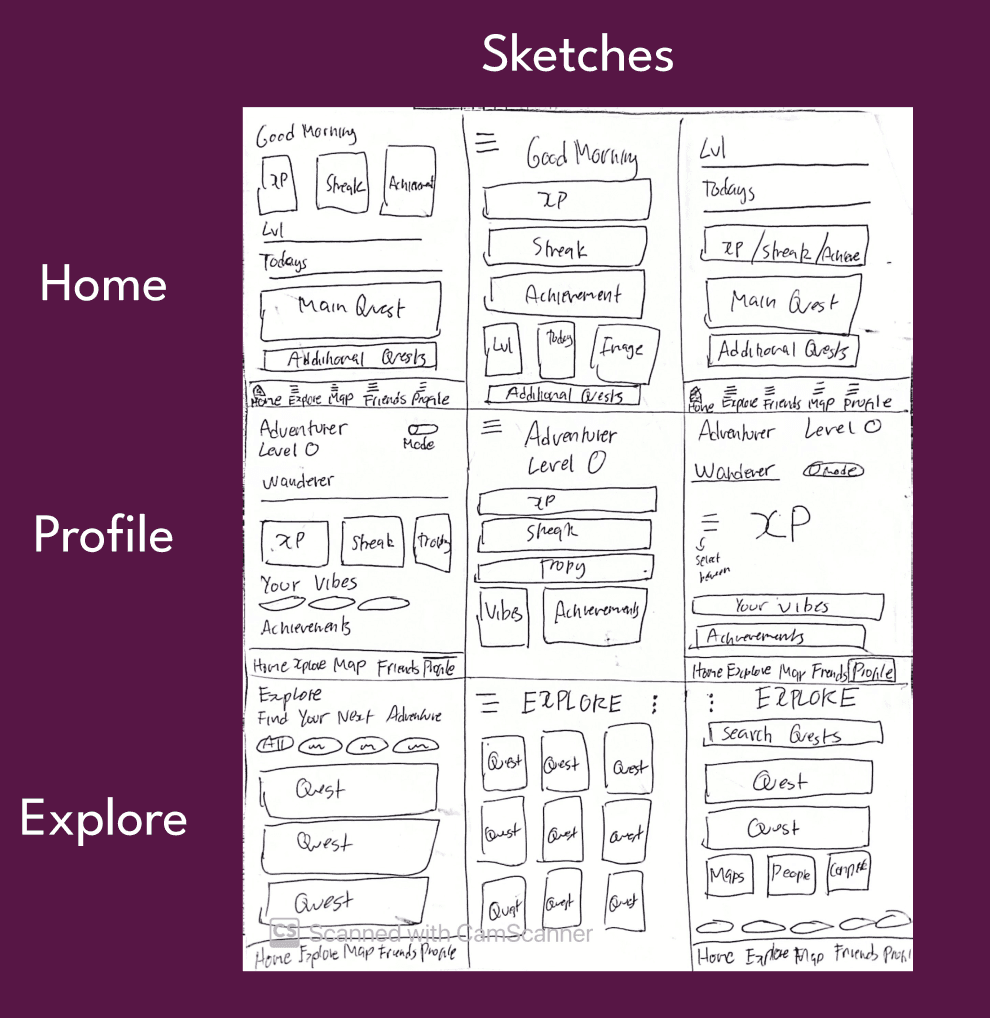
Initial sketches — exploring the commitment and discovery flows
Initial assumption vs. what I learned
Started thinking: people don't start new activities because they don't have enough time.
Learned:time wasn't the constraint — effort was. People had pockets of available time but the energy required to decide what to do with them was itself a blocker. The design challenge shifted from "help people find time" to "reduce the effort to start."
Action
Every design decision was evaluated against one question: does this make it faster and easier to start, or does it add to the decision burden?
Establishing the core loop
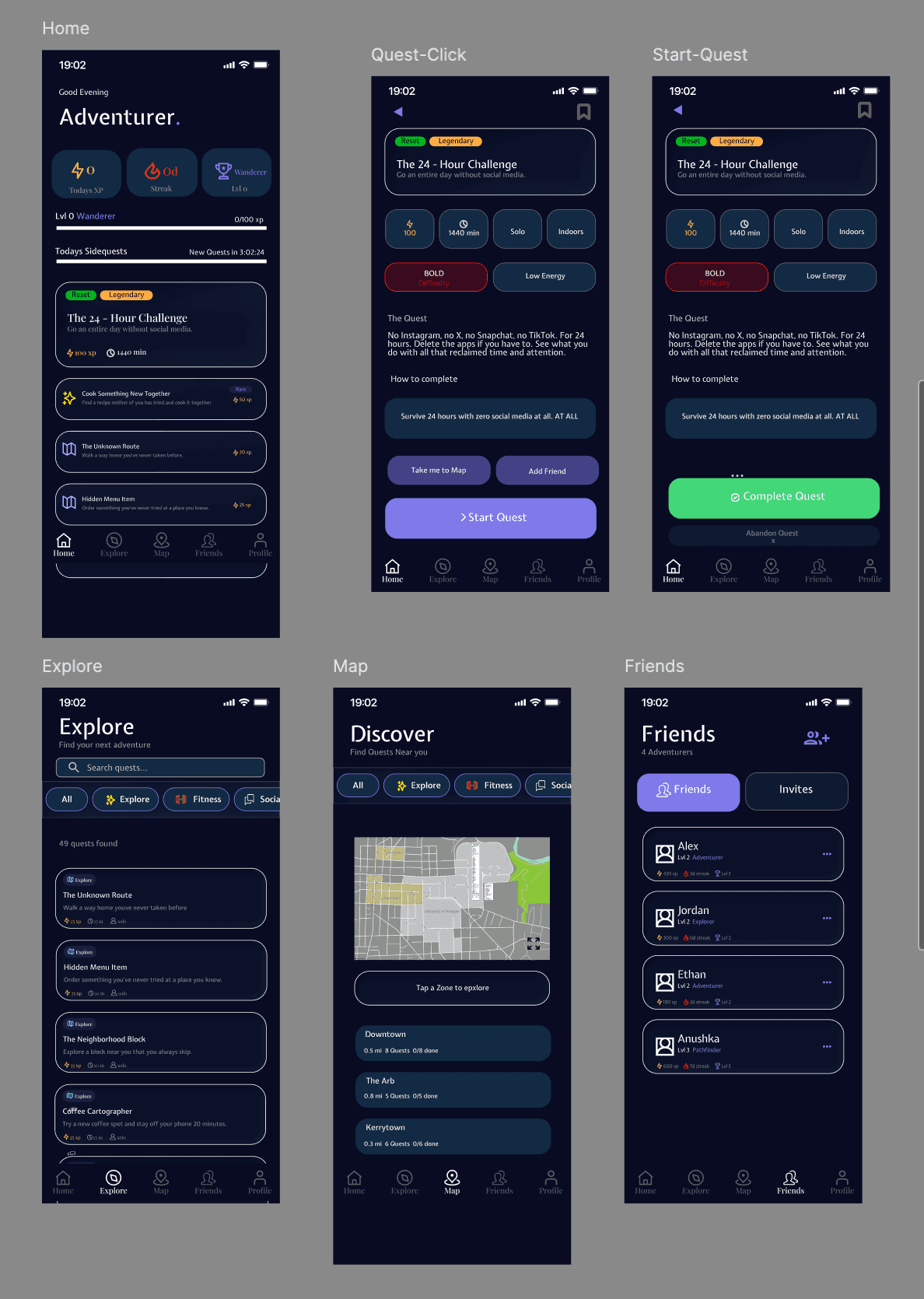
Wireframes — discover → commit → track
The wireframes established the core loop: discover an activity, commit to it with minimal friction, and track progress. Early versions separated browsing and committing into different flows. I collapsed them — the commit action had to be immediately available from discovery, or the moment of motivation would pass. Every additional tap between "I want this" and "I'm doing this" was a drop-off risk.
Location-based discovery
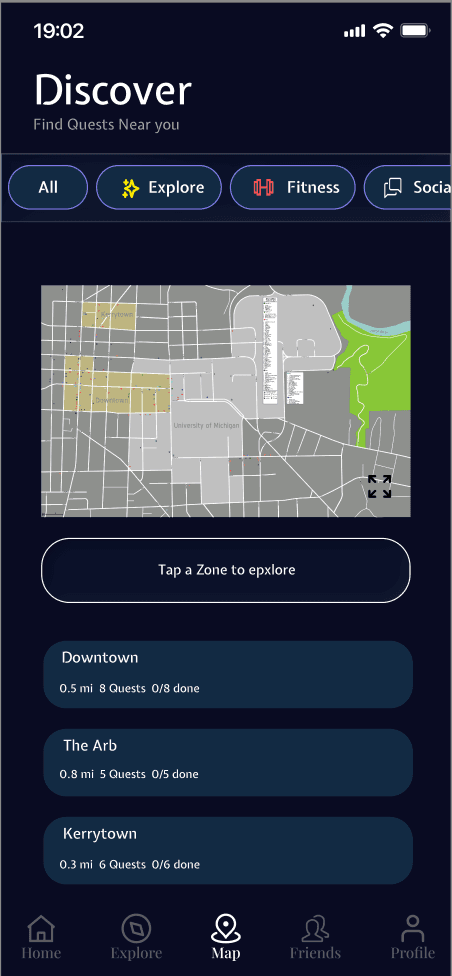
Map view — location-aware activity discovery
Location became a central design element after early concept testing surfaced a clear pattern: proximity was a strong signal for likelihood of follow-through. When an activity was nearby and visible on a map, the "I'll get around to it" excuse went away. The map view made the distance between wanting to do something and being able to do it concrete. That concreteness helped.
The quest card — designing for quick decisions
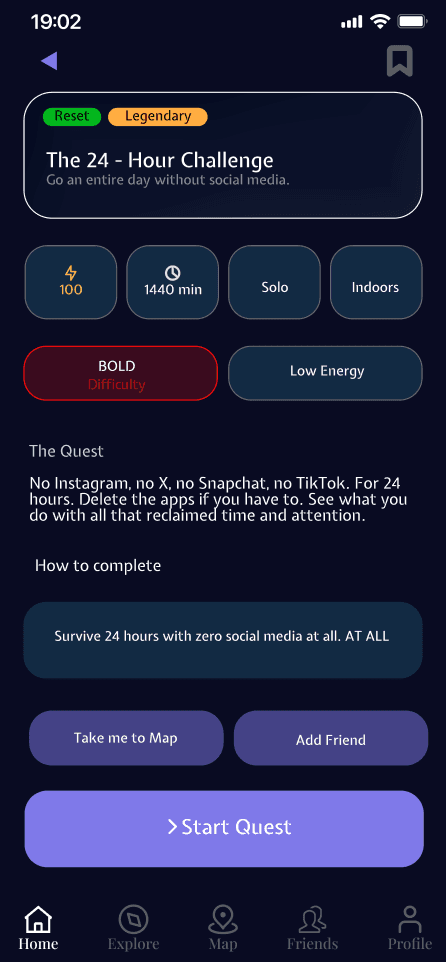
Quest card — compact, scannable, designed for fast decisions
The quest card became the core UI unit — the element that carries all the information a user needs to decide whether to commit. I kept it deliberately compact: activity name, one-line description, proximity, and a single primary action. Removed ratings, comments, and extended detail from this view. If the card needed to show more to convince someone, it had already failed as a design. The detail view was available, but the card had to work on its own.
Refining the profile — before and after
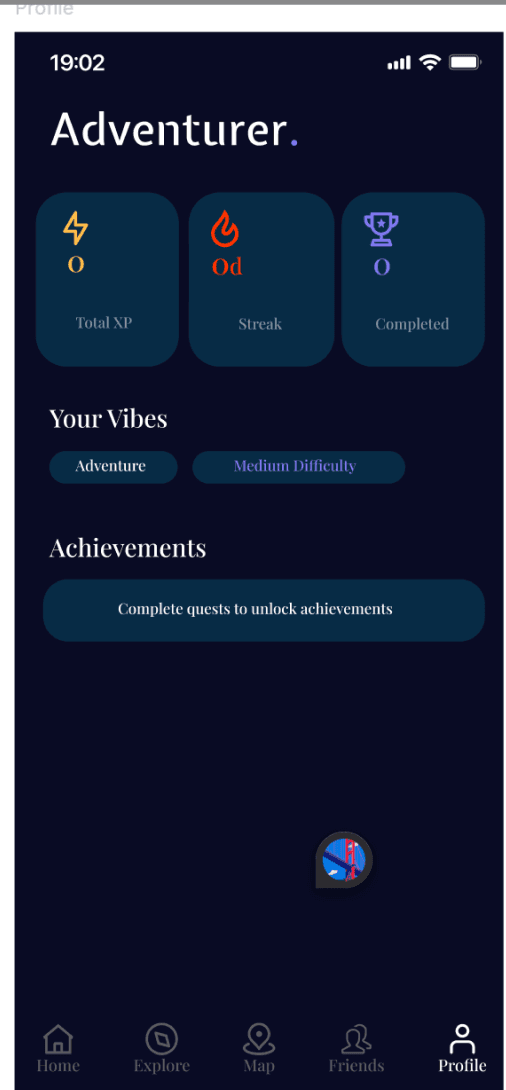
Before — active quests buried
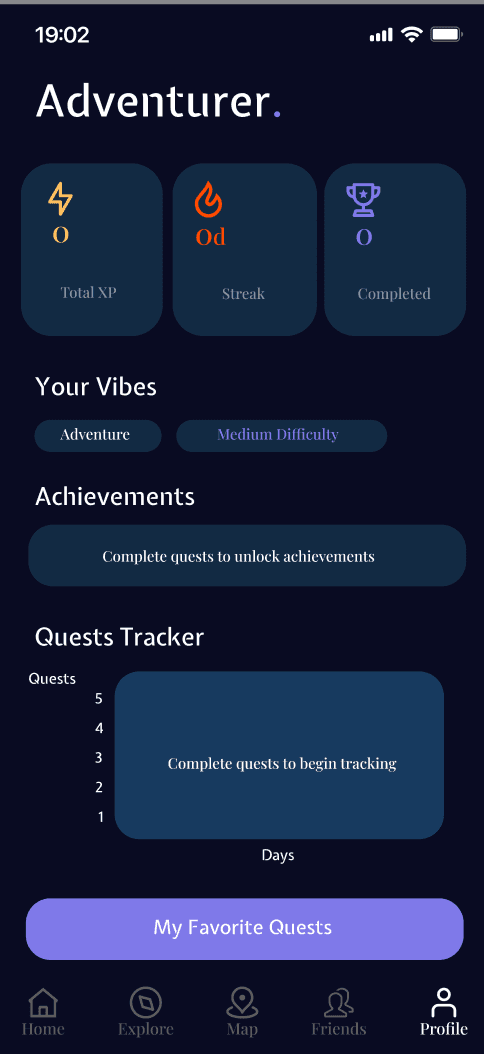
After — quests front and center
The profile page revision was driven by one observation: in the original design, the user's active quests were buried below stats and badges — the things they were actually doing were less visible than the metrics about what they'd done. I inverted the hierarchy. Active quests moved to the top. The stats moved to a secondary tab. The profile became a place to continue things, not just review them.
Result
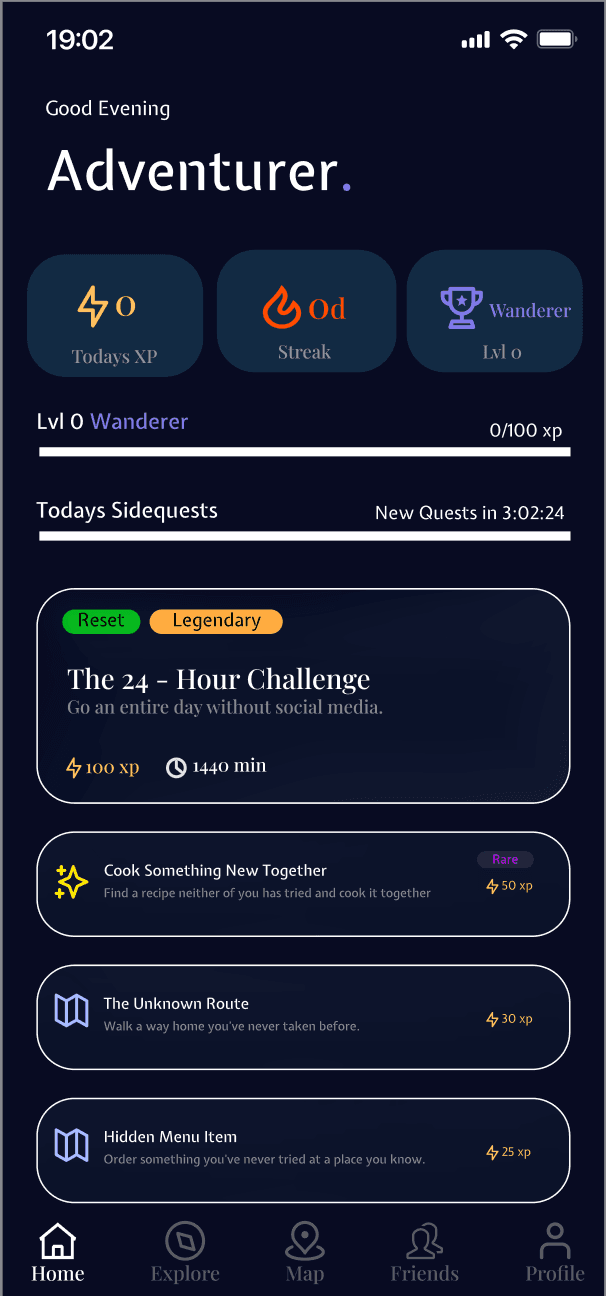
Delivered a full Figma prototype covering the complete SideQuest experience — from discovery to commitment to progress tracking.
Location discovery
Proximity-aware browsing that surfaces activities close enough to actually do
Map exploration
Visual map view that makes nearby activities concrete, not abstract
Quick quests
Compact quest cards designed for fast, confident commitment decisions
Progress tracking
Lightweight tracking that confirms progress without becoming overhead
Personalization
Interest-based filtering that narrows choices without overwhelming
Saved quests
Save for later — reduces the pressure to decide in the moment
Key finding
Reducing the decision surface — fewer choices, more opinionated defaults, faster commit path — made the product feel more useful at every iteration. Adding features made it feel more capable but less usable. The tradeoff is real, and "less" won every time.
Reflection
“The biggest design insight was that starting friction matters more than feature depth. People don't need a better reason to do something — they need a shorter path to doing it. Fewer steps, clearer defaults, immediate action.”
Next steps would focus on recommendation quality and retention. Discovery is only the first problem — getting people to come back after their first quest is a different design challenge entirely, and one I haven't solved yet.
Explore the full design
View Figma Prototype